
📝 Blog Summary
The traditional debate between Asterisk and FreeSWITCH has evolved. In 2026, the real contest has moved beyond dial plans or office PBX features. Now, it’s more about how cleanly a telephony engine pipes raw full-duplex audio into streaming speech-to-text, large language models, and neural voice synthesizers.
While both platforms are developer frameworks rather than turnkey PBX software, their architectures handle real-time media streams very differently. This blog will help you compare FreeSWITCH vs. Asterisk, evaluate mod_audio_stream against AudioSocket, break down WebRTC and SIP integration, and get a clear engineering decision matrix.
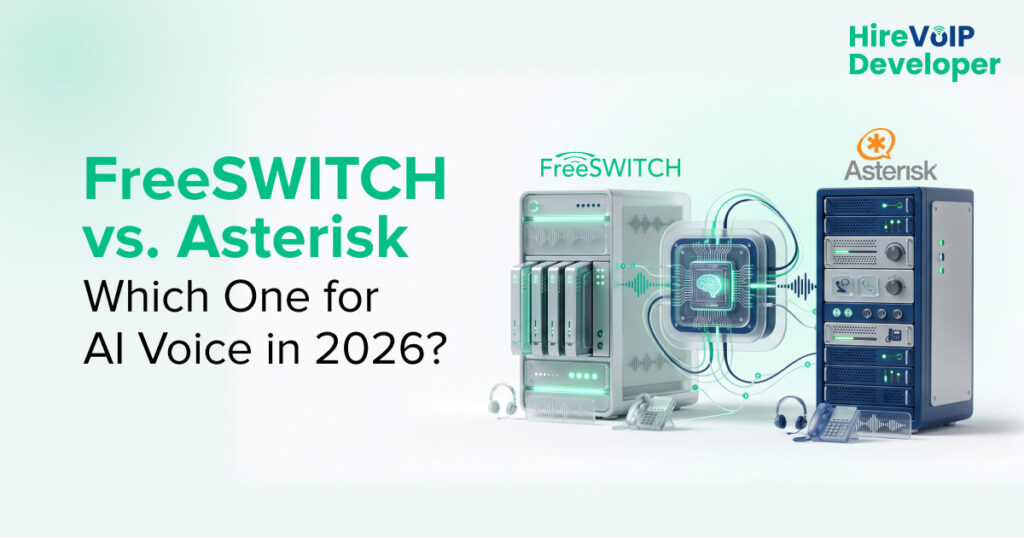
When it comes to FreeSWITCH vs. Asterisk for AI voice, it comes down to an architectural trade-off: FreeSWITCH provides superior per-node concurrency and low-latency WebSocket media forking for high-scale voice agents. Asterisk offers faster dialplan setup, mature application APIs (ARI and AudioSocket), and simpler integration for contact centers handling under 1,000 concurrent channels.
The growth of conversational AI bots, LLM speech agents, and browser-native WebRTC softphones has fundamentally rewritten telecom engineering requirements.
An enterprise voice engine can no longer just bridge Call Leg A to Call Leg B. It must act as an ultra-low-latency, full-duplex media pump that captures acoustic frames from a caller, pushes them over WebSockets or raw TCP sockets to an inference engine, and plays back synthesized audio without robotic jitter or clipping.
Whether you are looking to build an AI voice agent with FreeSWITCH and WebRTC or upgrading an existing communications cluster, this blog breaks down the real architectural trade-offs you face in production.
The Difference Between Telephony Engines and PBX Software
A persistent point of confusion on technical forums is whether FreeSWITCH and Asterisk are phone systems in their own right, and where software like FreePBX or FusionPBX fits into the picture.
Well, neither FreeSWITCH nor Asterisk is an out-of-the-box PBX. Both are open-source telephony engines and application development frameworks.
The engine layer provides the C and C++ primitives that manage RTP streams, negotiate audio codecs, terminate SIP signaling, and bridge audio channels. They do not come with user portals, web interfaces, or point-and-click extension managers.
The PBX GUI layer provides web-based management suites built on top of the engines. FreePBX is a web-based GUI that configures Asterisk dial plans and database states behind the scenes. FusionPBX is a multi-tenant web application that orchestrates FreeSWITCH XML configurations.
If you need a turnkey office phone system running within two hours, you install FreePBX (Asterisk). But if you are building an autonomous, high-throughput voice AI platform, an enterprise CPaaS core, or a multi-tenant softswitch, you configure the underlying engines directly.
FreeSWITCH vs Asterisk Architectural Comparison | How Their Cores Handle Media and Signaling
The operational differences between Asterisk and FreeSWITCH stem from how their software cores process channels, allocate memory, and manage hardware threads:
Asterisk: Dialplan-First, Application-Centric
Originally designed in 1999 around traditional PBX dialplans, Asterisk routes calls sequentially through contexts, extensions, and priorities.
With legacy chan_sip removed entirely in Asterisk 21, Asterisk 22 and 23 rely exclusively on res_pjsip. This modern architecture brings multi-threaded SIP parsing and clean RFC compliance.
For developers, Asterisk exposes the Asterisk REST Interface (ARI). ARI gives external applications direct programmatic control over channels, bridges, and media endpoints via REST calls and WebSocket events, making it straightforward to build custom call logic using standard web services.
FreeSWITCH: The Asynchronous Event-Driven Switch
Released in 2006, FreeSWITCH was built from the ground up as a carrier-grade softswitch. It eschews linear dialplans in favor of a state-machine architecture managed through the Event Socket Layer (ESL).
An external application connects to FreeSWITCH over a TCP socket, subscribes to specific events (CHANNEL_CREATE, CHANNEL_ANSWER, DTMF), and fires non-blocking commands via a background API (bgapi).
This makes FreeSWITCH exceptionally resilient: a slow database query or crashing external script never stalls active media threads inside the core switch.
Streaming Call Audio to AI Models With mod_audio_stream vs AudioSocket
When deploying an interactive voicebot, the critical engineering constraint is end-to-end media turnaround time. For a human-to-AI conversation to feel natural, total system latency must remain under 600 to 800 milliseconds. Your telephony layer must capture, resample, and stream bidirectional Linear16 (L16) audio without adding buffer delays.
FreeSWITCH: mod_audio_stream and mod_audio_fork
FreeSWITCH taps media directly through its native C-level media_bug API. Modules like mod_audio_stream (and its predecessor mod_audio_fork) attach directly to the channel session, duplicate raw audio frames in memory, convert them to 8kHz or 16kHz L16 PCM, and stream them over full-duplex WebSockets.
Crucially, it handles bidirectional media natively: your Python or Node.js agent can stream synthesized audio chunks back down the exact same WebSocket connection, and FreeSWITCH plays them immediately to the caller.
Asterisk: AudioSocket and ARI External Media
Asterisk streams audio through two main interfaces:
- AudioSocket: A built-in dialplan application that opens a plain, unencrypted TCP socket to an external server. It sends a 3-byte header followed by raw 16-bit 8kHz signed linear audio in fixed 320-byte (20ms) chunks. While fast and lightweight, it uses raw TCP rather than native WebSockets, requiring your AI bridge to run a custom socket listener.
- ARI External Media: Asterisk creates a separate external media channel that sends and receives RTP over dynamic UDP ports. While modular, it forces you to run an RTP endpoint alongside your AI backend.
The Media Verdict?
FreeSWITCH wins on modern protocol alignment. Its native WebSocket media bugs match the streaming interfaces expected by major AI voice pipelines (such as OpenAI Realtime API, Deepgram, and Cartesia) without requiring custom TCP-to-WebSocket translation proxies.
FreeSWITCH vs Asterisk Performance and Concurrency Benchmarks
When comparing FreeSWITCH vs. Asterisk performance, FreeSWITCH delivers substantially higher concurrent call density per compute instance:
For office systems or small call centers with fewer than 500 lines, raw hardware throughput is rarely the limiting factor. A tuned Asterisk server handles standard business loads without strain.
However, if you are building an autonomous AI voice platform where every single call requires a dedicated real-time audio fork, FreeSWITCH’s smaller memory footprint and isolated session threads provide far better economic density per cloud instance.
💡 VoIP Expert Tip
Never force your AI media switch (whether Asterisk or FreeSWITCH) to handle carrier-level transcoding while actively running media bugs.
If a call arrives as G.711 and must be transcoded to Opus before forking out L16 PCM over WebSockets, the CPU resampler will cause micro-jitter under load.
Deploy an edge Session Border Controller (such as Kamailio) to normalize incoming carrier traffic to uniform 16kHz linear audio before hitting your media nodes.
WebRTC and Browser-Based Voice Support
Building browser softphones for human-in-the-loop escalation or customer-facing web calls introduces encryption and traversal challenges:
- FreeSWITCH (mod_verto & SIP over WSS): FreeSWITCH was an early pioneer in browser telephony. It includes mod_verto, an integrated JSON-RPC signaling protocol designed specifically for WebRTC clients, avoiding complex SIP-over-WebSocket parsing inside the browser. It also handles DTLS-SRTP encryption, Opus transcoding, and ICE candidate exchange natively with minimal configuration.
- Asterisk (chan_pjsip WSS): Asterisk supports WebRTC via secure WebSockets (transport-wss) and PJSIP endpoints. It requires configuring DTLS certificate files, enabling ice_support=yes, and setting media_encryption=dtls. While functional and production-proven, it requires more manual configuration and careful browser-side SIP library tuning.
FreeSWITCH vs Asterisk: Which Platform Fits Your Stack for Voice AI?
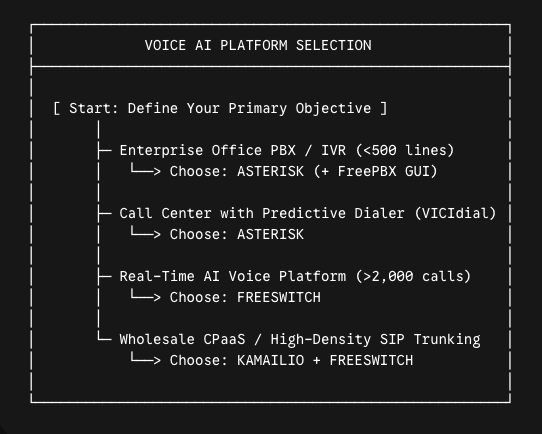
Choose Asterisk if:
- You Need Fast Time to Production: Asterisk’s dialplan syntax, extensive community documentation, and ready-made integrations let you launch a working system in days.
- You Rely on Turnkey PBX Tools: If you need a web GUI, voicemail-to-email, extension queues, and administrative panels without building custom software, the Asterisk and FreePBX ecosystem is unmatched.
- You Run Established Call Center Software: Industry-standard predictive dialing tools like VICIdial are built directly on Asterisk.
Choose FreeSWITCH if:
- You Are Building a Scalable Voice AI Product: You need full-duplex WebSocket media streaming (mod_audio_stream) that connects directly to cloud speech models with sub-second latency.
- High Concurrency Is Critical: You expect to run thousands of simultaneous active calls on single instances without hitting shared memory locks.
- You Require Multi-Tenant Architecture: FreeSWITCH separates domain configurations natively, making it the superior framework for multi-tenant SaaS telephony platforms.
The Hybrid Approach: Combining FreeSWITCH, Asterisk, and Kamailio for Voice AI
In large enterprise systems, you don’t have to pick just one. The most scalable telephony architectures deploy a decoupled, multi-tiered stack:
- Kamailio or OpenSIPS acts as the high-throughput edge SIP proxy and firewall, terminating carrier connections, deflecting malicious scans, and load-balancing traffic across internal media nodes.
- FreeSWITCH acts as the dedicated AI media forking engine, handling streaming WebSockets to AI models and processing high-density WebRTC sessions.
- Asterisk handles complex internal call routing, agent queues, and legacy office PBX features where its rich application ecosystem excels.
To explore how edge proxies integrate with media switches, read our comparative breakdowns on Kamailio vs Asterisk and Kamailio vs FreeSWITCH.
Selecting the wrong telephony core can lock your business into costly re-architectures. Whether you need the rapid development ecosystem of Asterisk or the carrier-grade concurrency of FreeSWITCH, building low-latency AI voice bridges requires seasoned telecom engineering.
At Hire VoIP Developer, we build, optimize, and maintain production telephony systems for startups, contact centers, and global carriers. Whether you need to:
- Integrate full-duplex WebSocket media forking for voice AI agents
- Build high-density WebRTC gateways
- Optimize high-throughput Asterisk or FreeSWITCH clusters
You can hire a dedicated FreeSWITCH engineer or hire an Asterisk specialist to join your team and build a stable, scalable telephony foundation.